

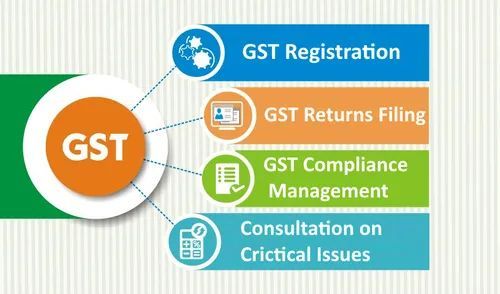
GST Registration & Filing Services
The Goods and Services Tax (GST) is an indirect tax on goods and services consumed in India. GST replaced several indirect taxes such as excise duty, VAT, and service tax and came into force on 1st July, 2017.
GST is governed by the Goods and Services Tax Act passed by the Indian Parliament on March 29, 2017 and applies uniformly across India.
Taxable Person under GST
A taxable person under the GST Act is someone who conducts business in India and is registered or liable to be registered under GST.
A taxable person may be an individual, HUF, company, firm, LLP, AOP/BOI, corporation, government company, cooperative society, trust, local authority or artificial juridical person.
GST Registration Turnover Limit
GST registration can be obtained voluntarily irrespective of turnover. However, registration becomes mandatory once turnover crosses the prescribed limit.
Service Providers
Any service provider with aggregate turnover exceeding ₹20 Lakhs in a financial year is required to obtain GST registration. For special category states, the limit is ₹10 Lakhs.
Goods Suppliers
As per Notification No. 10/2019, suppliers of goods must obtain GST registration if turnover exceeds ₹40 Lakhs, subject to the following conditions:
- Supplier should not provide any services
- Supplier should not make intra-state supplies in certain states
- Supplier should not deal in ice cream, pan masala or tobacco
If the above conditions are not met, GST registration becomes mandatory at ₹20 Lakhs (₹10 Lakhs for special category states).
Special Category States
Arunachal Pradesh, Assam, Jammu & Kashmir, Manipur, Meghalaya, Mizoram, Nagaland, Sikkim, Tripura, Himachal Pradesh and Uttarakhand.
Aggregate Turnover
Aggregate turnover includes taxable supplies, exempt supplies, exports and inter-state supplies and is calculated on the basis of PAN.
Types of GST Registration
- Regular Taxable Person
- Casual Taxable Person
- Non-Resident Taxable Person
- E-Commerce Operator
Casual taxable persons, non-resident taxable persons and e-commerce operators must register under GST irrespective of turnover.
What is GSTIN?
GSTIN (Goods and Services Tax Identification Number) is a 15-digit identification number issued to GST-registered entities. It is based on PAN and the State of registration.
GST Registration Certificate
Registered persons are required to display the GST Registration Certificate prominently at their place of business. The certificate can be downloaded from the GST portal.
Voluntary GST Registration
Businesses can opt for voluntary GST registration to avail input tax credit and issue GST invoices to customers.
Penalty for Not Obtaining GST Registration
Failure to obtain GST registration within 30 days of becoming liable may attract a penalty of ₹10,000 along with loss of input tax credit.
Documents Required for GST Registration
Sole Proprietor / Individual
- PAN Card
- Aadhaar Card
- Photograph
- Bank Account Details
- Address Proof
LLP / Partnership Firm
- PAN Cards of Partners
- Partnership Deed
- Photographs of Partners
- Address Proof
- Bank Account Details
Company (Indian / Foreign)
- PAN Card of Company
- Certificate of Incorporation
- MOA & AOA
- Director & Authorised Signatory Details
- Board Resolution
- Bank Account Details
- Address Proof
Benefits of GST Registration
- Helps in obtaining bank loans
- Easier supplier onboarding
- Mandatory for e-commerce selling
- Eligibility for Input Tax Credit
P4 Legal IP Associates assists clients with GST registration, compliance and filing to ensure smooth and timely GST operations.